Cheating Detection Benchmark Report: How Accurate is AI at Spotting Exam Fraud?
When taking an online test, how does a computer actually know if someone is cheating? As digital exams become standard for schools and companies, testing the real world accuracy of artificial intelligence has become crucial.
The Cheating Detection Benchmark Report breaks down how modern AI systems are tested, how accurately they spot dishonest behaviour, and what red flags they look for during an exam.
1. The Multimodal Approach: Watching the Whole Picture
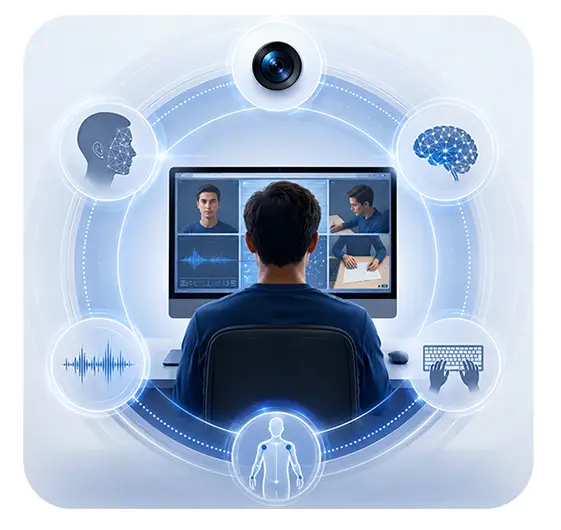
Simply tracking where a student looks is no longer enough to catch cheating. Modern AI benchmarks demonstrate that accurate detection requires examining multiple clues simultaneously.
According to benchmarking research published in Mendeley Data, researchers tested AI systems using 5,500 real time behavioural snapshots packed with 38 distinct movement markers:
- Five Core AI Signals: The benchmark tests how well AI tracks face count, hand movements, head position (turning or tilting), phone presence, and eye direction.
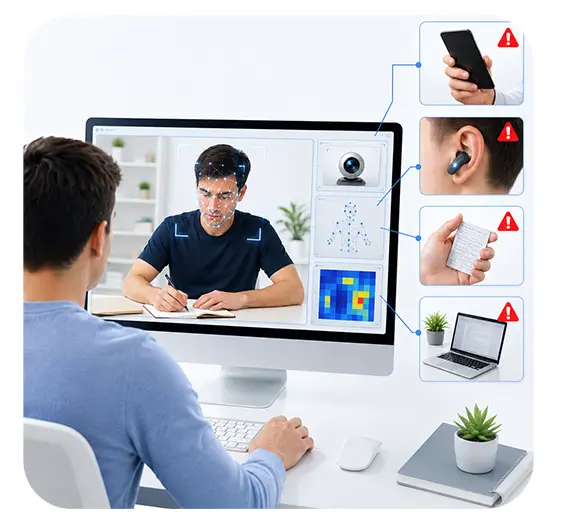
- The Biggest Red Flags: The data revealed that hands reaching for off- screen objects and the visible presence of a mobile phone were the single strongest indicators of cheating, followed by turning the head completely away from the screen.
- Higher Accuracy: Combining all these visual cues together dramatically reduces mistakes compared to relying on basic eye tracking alone.
Community benchmark sets, such as the Kaggle ExamCheating Dataset, allow developers to test how well AI spots subtle real world actions, like passing physical notes or peeking at a neighbour.
2. Computer Vision: Spotting Suspicious Objects Fast
To work smoothly during a live exam, AI camera software needs to process video frames in milliseconds without crashing the candidate's computer.
A benchmark study featured by AIP Publishing evaluated smart visual detection AI on thousands of exam images:
- High Visual Accuracy: The tested visual AI achieved strong accuracy scores (a 0.719 mAP precision rating) when automatically categorising candidate actions into "honest" versus "cheating" states in real time.
- Whisper & Mouth Tracking: Instead of just watching body movements, advanced visual AI maps facial landmarks around the lips. If mouth movements pass a specific threshold, the AI alerts the system to potential talking or whispering.
3. Smart Grade Patterns: Spotting Impossible Score Jumps
AI proctoring isn't limited to cameras. AI can also analyse a student's past performance to flag statistical anomalies.
A peer reviewed study published in PLOS ONE benchmarked an AI model designed to analyse a student's grade history throughout a semester:
- Predicting Realistic Results: The AI evaluates a student's previous quiz, project, and midterm scores to estimate a realistic final exam range.
- Flagging Unnatural Spikes: If a candidate who consistently scored 50% across all past assignments suddenly gets a perfect 100% on a complex final exam, the AI flags the sudden score jump as a potential outlier for human review.


Key Takeaway
The latest cheating detection benchmark data shows that the best online protection doesn't come from aggressive camera monitoring alone. The most reliable AI combines real-time visual tracking (hands, objects, and face) with smart performance data to make online testing fair and accurate for everyone.
Book a Demo